
ITALIANS IN KENYA
14-10-2026 by Freddie del Curatolo
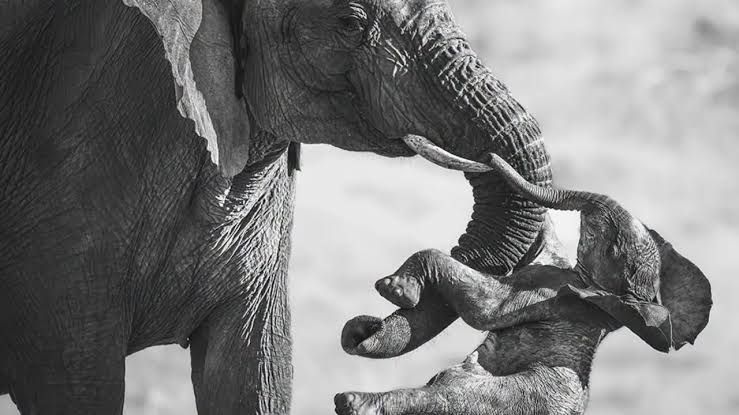
We’ve got the best in the world! And this isn’t a stadium chant, but a proud round of applause for Federico Veronesi, an Italian living in Kenya who has won the most prestigious international nature photography award.
Sometimes it takes a lifetime to capture a single shot. In Federico’s case – born in Milan in 1975 – it took a first safari in Kenya as a child, a degree from Bocconi University, the courage to abandon a conventional career, and thousands of days spent observing African animals. Today, that choice has been recognised on a global stage: his photograph The Aftermath has won the Wildlife Photographer of the Year 2026 award.
The award-winning photograph was taken in the Huab River valley, in Damaraland, Namibia. Veronesi was following the tracks of a herd of elephants when he noticed some unusual marks on the sand of the dry riverbed, left by something that had been dragged along. Following them, he caught up with the herd and witnessed an unexpected scene: a female was carrying her calf’s body, with one of its legs trapped between its tusk and trunk.
The title, The Aftermath, alludes to what remains after a painful event, to its consequences and to that grey area where life must come to terms with loss. The black-and-white imagery eliminates any chromatic distractions and focuses the viewer’s attention on the animal’s gesture, its posture, and the weight of the body it is carrying.
The photograph won over the jury from a record number of 65,403 entries from 121 countries and territories. For Kathy Moran, chair of the jury, the image is both an emotional wound and a testament to the cognitive abilities of animals. This assessment captures the essence of a work capable of transcending mere naturalistic documentation.
Elephants display complex behaviours in the face of death: they may remain beside the bodies, touch them, examine the remains, vocalise or even carry the deceased. Science continues to explore the meaning of these behaviours, with hypotheses ranging from mourning and recognition of death to other forms of response to loss. It is not necessary to attribute feelings identical to our own to animals in order to recognise how much of their inner life still eludes us.
And it is precisely in this space, between scientific observation and emotion, that Veronesi’s photography finds its strength. It does not explain, nor does it claim to provide answers: it presents a scene and leaves it to the viewer’s gaze to grapple with the questions.
From his first safari to life on the savannah
For those who have been following his work for years, including via Malindikenya.net, this award does not come out of the blue. In December 2023, we told his story in the article Veronesi: a life spent capturing portraits of African animals, dedicated to a photographer for whom wildlife is much more than a professional subject: it is his reason for living.
His first major international breakthrough came in 2009, with a photo essay dedicated to the caracal, one of the continent’s most elusive big cats. Small compared to the large predators, elusive and difficult to spot, this animal became one of his specialities. Veronesi managed to document its life and, over the years, also followed several females with their cubs, transforming exceptional encounters into in-depth knowledge.
His images appear in international magazines and have won awards. But his style is not limited to the rarity of the subject or technical perfection. In his portraits of lions, leopards, cheetahs and elephants, he seeks something that often eludes more conventional wildlife photography: the animal’s character, its solitude, its relationship with others, and the way it inhabits its own world.
Black and white becomes his signature style, as does his use of light, backlighting and contrasts. These are not mere aesthetic exercises. They serve to isolate a posture, an expression, a movement, suggesting that behind every animal lies a story we are not accustomed to seeing.
In the book One Life, which we have also featured in our pages, this vision takes the form of a journey through Kenya, Tanzania, Zimbabwe and Namibia. The savannah becomes a grand metaphor for existence, with its encounters and partings, the changing seasons, growth, survival and bonds of affection. The life of the photographed animal and that of the photographer thus become intertwined without merging.
A new book, elephants and global recognition
In March this year, our Incontri Italiani festival also hosted the Nairobi launch of Walk the Earth, Veronesi’s new photography book dedicated to elephants. It marks a return to one of the animals he loves most, after years spent documenting big cats and their often-hidden lives.
It is significant that it was an elephant – this time a mother grappling with the loss of her calf – that earned him the most important award of his career. Not a spectacular image of a hunt or a chase, not the power of a predator nor the wonder of a landscape. Rather, a gesture that is difficult to interpret and impossible to dismiss with indifference.
The Wildlife Photographer of the Year competition, organised by the Natural History Museum in London and now in its 62nd edition, is one of the most prestigious international awards for wildlife photographers. The exhibition featuring the hundred selected images opens on 16 October and will run until 11 July 2027.
For Veronesi, who continues to lead photographic safaris in sub-Saharan Africa, the award is also a confirmation of the value of work built on direct knowledge of nature. In an age when images can be digitally generated or manipulated, the photographer has emphasised the importance of authenticity and fidelity to what actually happened in front of the lens.
His photography needs not to add anything to the scene, nor to transform it into a human fairy tale. It is enough simply to show a female elephant who never leaves her calf’s side, crossing a dry riverbed in an African landscape.
And perhaps this is precisely the deepest meaning of this accolade: after a lifetime spent tracking animals across the savannah, Federico Veronesi has captured an image capable of holding the world’s gaze. Not because it reveals some ultimate secret about nature, but because it reminds us just how vast the part of it remains that we must still learn to understand.


NAIROBI EVENTS
by redazione

A truly special Italian event is taking place this month, on Tuesday, March 24: together....
ITALIANS IN KENYA
by Freddie del Curatolo

"One Life", the life of a great Italian photographer in Kenya, enclosed and unleashed in that of...
by Freddie del Curatolo

This coming Saturday and Sunday, the exhibition of Italian nature photographer Paolo Torchio, entitled...
WILDLIFE
by redazione

Good news for wildlife in Kenya, and particularly in its capital city, at a time when between climatic woes...
WILDLIFE
by Freddie del Curatolo

This is the most beautiful photo in the Maasai Mara in 2020 by an Italian photographer.
Paolo...
PHOTOS AND ART
by redazione

Australian photographer Shravan Rao has been named the Maasai Mara Wildlife Photographer of the...
EXHIBITION
by redazione
This coming Saturday and Sunday, as part of Roberto’s Cellar’s Heritage Nights at the Rosslyn Mall, the...
WILDLIFE NEWS
by Freddie del Curatolo
(Photo by Federico Veronesi) His tusks told the story of an Africa that seemed to belong to another era, when great elephants roamed...
NATURE
by Freddie del Curatolo

The 2021 edition of "The greatest Maasai Mara Photographer of the year" competition, which...
NEWS
by Leni Frau

A giraffe with her young, surrounded by the serenity of the Mara Conservancy in the...
WILDLIFE
by Freddie del Curatolo

At least 50 elephants were sedated, put to sleep, tied up and hoisted onto tractor-trailers to be...
EVENTS
by Freddie del Curatolo

Prehistoric rock art is one of the least known but most fascinating cultural attractions of this country that...


