
BOOKS ABOUT AFRICA
29-06-2026 by Freddie del Curatolo

Sansone Banin, who for years has been radiating his aura of affable wisdom just a stone’s throw from Diani Beach, is one of those people you simply must meet – perhaps whilst enjoying a relaxing holiday at his boutique hotel. A man well into his nineties with lively, magnetic eyes, he is a delight to listen to.
But it is just as fascinating to discover the story of his adolescence by reading the autobiographical coming-of-age novel that bears his name (‘Sansone’, Oltre Edizioni, Narrazioni series, 346 pages, €21).
A novel that is, above all, historical, offering a journey into the colonial past of a nation that is by no means unknown to us Italians – Eritrea – but which the author brings to life through his family’s memories, his own thoughts as a young man and, above all, a cast of characters portrayed in a manner that is at times passionate and moving, at times almost legendary, and at others ironic and amusing.
A very well-written and detailed novel, which surprises with the clarity of the countless ‘photographs’ of a memory that, as you turn the pages, seems far less distant.
Banin, born in Asmara in 1933 to a family from the British Jewish community but raised amongst Italians to the point of feeling one of them, the youngest of ten siblings and fatherless from a very tender age, reconstructs a world that has now almost vanished: that of Italian Eritrea, a crossroads of peoples, religions and cultures. Eritreans, Italians, Jews and Arabs coexist in a fragile yet extraordinarily vibrant balance, whilst from Europe come the muffled but inexorable echoes of fascism, racial laws and war. It is a society in limbo, seemingly far removed from History with a capital H, which will instead end up being swept away by it.
The book’s great strength lies precisely in this: recounting historical events without ever becoming an essay. Yet certain themes it touches upon – ranging from simplistic ethnic and religious labelling to the fear of darker times – are so relevant today that one might expect parallels or moral judgements.
Instead, it is the story of the Banin family – with its business successes, friendships, romances, rivalries and sudden tragedies – that serves as the central thread. Through the eyes of the youngest son, the reader is taken on a journey through a world of trade, travel, surprising encounters and memorable characters, in which reality often takes on the contours of an adventure novel.
Furthermore, from the very outbreak of the war between Italy and Ethiopia, *Sansone Banin* succeeds in vividly capturing the cosmopolitan spirit of Asmara in those years – a city that was Italian without ever truly being solely Italian, and which still bears deep traces of that era today. There is no nostalgia for its own sake, but rather a desire to preserve the memory of a unique society, with its contradictions, its injustices and its extraordinary human richness.
There are the main characters: Grandfather Banin, the three sisters, the industrious brothers and the playboys, Engineer Roberto Fermi; and then there are the supporting characters – countless in number – sometimes sketched in just a few lines, yet as vivid as in a film’s tracking shot. You can almost picture them: Andrea the pastry chef, the misogynistic friend Attilio, the femme fatale Vanda Di Maggio, the Ovra agent Luciano, Professor Miserocchi, and a procession of soldiers and colonels, priests and nuns, friends and lovers of brothers and sisters, as well as the places, starting with ‘Casa Grande’ on Corso del Re. This journey would lead him, at the age of sixteen, to become one of the first young people from the Jewish community of Asmara to move to the newly founded State of Israel in 1949. Life and work would then take him to other parts of Africa – Tanzania, Nigeria, Ghana – and finally to Kenya, where many Italians have had the good fortune to meet him.
Anyone familiar with Sansone of Diani – the tireless hotelier who contributed to the development of luxury hospitality on the Kenyan coast and who, together with his wife Caterina, still runs the charming boutique hotel Maji – will also discover the source of his inexhaustible curiosity and his ability to always look ahead.
‘Sansone’ is therefore much more than an autobiography. It is a testament to a cosmopolitan Africa that few remember, the story of a community scattered by the course of history and, at the same time, a coming-of-age novel capable of captivating the reader from the first page to the last. A book recommended not only to those who love stories of Italians on this continent, but also to anyone wishing to understand a little-known chapter of the Italian presence in the Horn of Africa through the eyes of someone who truly lived it.


On Thursday, Nov. 1, at 7 p.m., entomologist and writer Roberto Czeppel, a leading expert on Africa, will...
NEWS
by redazione

A documentary about Italians in Kenya. And 'the idea, supported by the Italian Institute of Culture in Nairobi, the Italian director Giampaolo Montesanto.
Montesanto has recently completed and put into service a similar feature, the Italians in Eritrea and is ready to...

Karen Dinesen Blixen lived in Kenya from 1914 to 1931.
She came there from the icy Denmark with her husband, baron Von Blixen, to buy a plot on the hills Ngong, near Nairobi, and build then a farm.
Rather being...
ROTOPODCAST
by redazione

There is one book which, more than many others, has helped to shape the romantic image...

It comes out these days in Italy the new novel by writer and director of Malindikenya.net Freddie del Curatolo.
The news, if you will, is that this time no mention of Kenya and Malindi.
It is in fact a story...
INSTITUTIONS
by redazione

A ‘changing of the guard’ at the helm of the Italian Trade Agency (ITA-ICE) in Nairobi. The...
BOOKS
by Freddie del Curatolo

Discovering Africa as a young woman for love, living its dreams and contradictions with the enthusiasm of...
ITALIAN EVENING
by Freddie del Curatolo

Alessandro Baricco, in the incipit of his novel Novecento, writes: ‘You are not really screwed as...

John Le Carré, well-known and appreciated writer of "spy stories" with social implications, has set his novel "The Tenacious Gardener" in Kenya, between the banks of Turkana and the slums of Nairobi.
DOCUMENTARY
by redazione
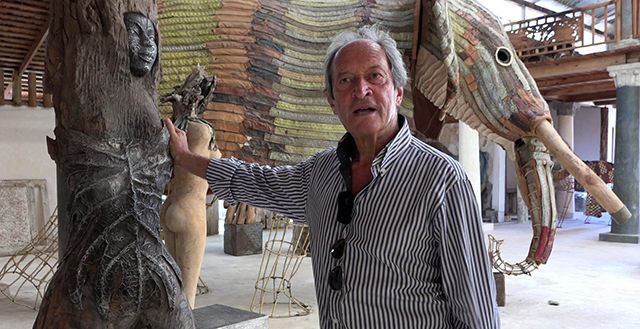
The filming of the documentary film "Italian in Kenya" has ended. It's a short feature commissioned by the Italian Foreign Ministry, through the Italian Institute of Culture in Nairobi, as part of the week of Italian language in the world.
ITALIAN PODCAST
by redazione

In this episode of the irregular and unexpected podcast series ‘L'Africa non esiste’ (Africa does not...
Appointments
by redazione

The appointment is not to be missed, for Italians who are in Malindi and surroundings in this period.
Saturday, October 15 at 18 at the National Museum of Malindi (former DC office, behind the square of change, Uhuru Garden) the...

Suggestive, supporting tourism and saving for the traffic of Mombasa, even if difficult to realize.
The project for a railroad that unites the tourist towns of Diani and Malindi exists and is part of the first electoral manifesto, in the...


