
OPINIONS
03-07-2026 by Michele Senici

It’s a little past five in the afternoon. The sun is about to dip behind the Shimba hills and my hair flutters in the wind like the fishermen on Lake Victoria, swaying to the hypnotic rhythms of the Ohangla.
The motorbike devours the tarmac whilst Daniel tames it, just as a skilled shepherd leads his fat cows.
I’m travelling home on a vital yet delicate mission: a few days ago, I accepted an invitation from John Mbiti, a Kenyan philosopher, to either refute or confirm his famous study on the concept of time in Africa.
An invitation that Mbiti extended to me in 1969 – with the impoliteness of doing so twenty-four years before I was even born, on another continent.
In short, one of those urgent and unavoidable matters that invariably end up occupying my motorbike journeys.
I have the nasty habit of smoking whilst riding. It’s an awkward choice because it involves, first of all, battling the wind; then, extinguishing the ember with fingers damp with saliva to prevent fires; and finally, holding onto the cigarette butt until I reach a bin.
However, even though there was nothing in the cigarette but tobacco, I look up and feel as though I’ve caught a glimpse of an answer.
I look at my hand and then look ahead: one after another, as the road curls back into itself after I’ve passed, I see the outlines of what will become houses rising up around me. The first one I notice is a well-built ground floor.
Three wide doors, each with its own little shop and a canopy to shelter the entrance.
On the left, a flight of stairs rising towards the sky. On the first floor, there is nothing but flat concrete and a few stumps of pillars that one day, perhaps, will even support a third floor. Further on, I notice another curious stub.
A square room made of brick walls and nothing else. Four metres on each side. Through the door facing the street, I catch a glimpse of a tree trunk, and above the four walls on which the tin roof should rest, the majestic canopy that has inhabited this place since long before the bricks were laid stands tall.
To my surprise, a little further on, I notice that this curious structure — which I saw take shape a few years ago, then remain unchanged for months, then be fitted with a roof, then come to a standstill again — is now occupied by small groups of labourers bustling busily in and out. Who knows what will come of it. Studio flats to let? Yet another trio of barber, butcher and kibanda? Who can say.
I don’t ask Dan to pull over, nor do I stop to ask questions; I stay where I am on the seat, letting their work continue at its own pace. And yet no one, looking at those incomplete walls, would call them unfinished. In Kenya, a house is something that is continually being worked on, not simply built.
The smell of the cigarette butt bothers me whilst Mbiti’s words ring in my mind. Time, in Africa, is not a pre-existing reality that awaits people. It is people who create it.
And if that is the case, then time cannot be squandered and, therefore, not even a house without a roof is wasted. Those houses are not incomplete: they are already what they are. One day, perhaps, they will become something else, if there is money, if the bricks arrive, if the need arises. In 1969, Mbiti was concerned about the clash between the African conception of time and that imported by the colonial powers.
Among the many things the Europeans had brought with them, he argued, was the idea of the distant future – a horizon to be planned, anticipated and pursued. An idea he regarded as both promising and dangerous: promising, if properly channelled; dangerous, if left to run unchecked. I ask Dan to turn back and stop in front of that room built around the tree.
Perhaps its owner had a specific plan in mind. Perhaps he already knew what it would become. Perhaps, as Mbiti would have hoped, he had learnt to look to the future. Or perhaps, quite simply, felling that thousand-year-old trunk was too costly – as was building the roof – and mine is merely the romantic projection of a passer-by. And yet the tree is still there. Protected by the walls that were meant to replace it. Enclosed within a structure that could have eliminated it but instead made room for it.
As if, whilst preparing for tomorrow, someone had decided to preserve a shelter already available today. A canopy under which to sit and rest, in case the money was slow to arrive, the bricks became more expensive or needs changed their mind. As if the future had been invited in, but not allowed to take over the whole house. The tree is still there. And the house continues around it.
I light a cigarette, put on my headphones. Bwana Nipe Pesa starts playing. Here we go again.
••• Michele Senici, 1993. Educator, teacher, project coordinator. I opened Casa Hera in Diani because I didn’t know where to continue my life. Do I understand it now? Certainly not, but that’s all right; at least I observe, think and write.


NEWS
by redazione

Up to five years in prison plus financial penalties for those who do not finish construction of ...
BIG 5 CONSTRUCT
by Freddie del Curatolo

When we speak of 'Italian excellence' and 'Made in Italy' to be showcased and exported around...
NEWS
by redazione
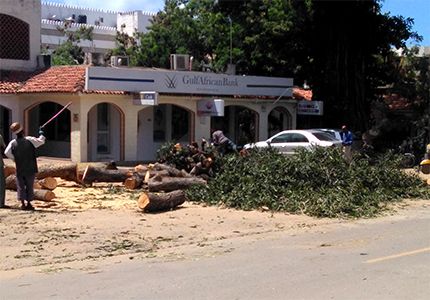
The justification is always the same: the old tree was sick and long-suffering, and it was necessary to break it down.
Certainly, cement-coated is also easier than suffering, in any case progress is also being made by these position cues.
KENYA NEWS
by Freddie del Curatolo

A worker has lost his life and several others have been injured following the collapse of part of...

There are more than 740 thousand Kenyans who have lost their jobs this year due to the pandemic...
STORIES
by Freddie del Curatolo

This is the story of a great tree that, with the years, has the humility to return to the earth after each ascension, and reborn stronger and wiser than before.
But it is also the story of human cruelty, that...
EVENTS
by redazione

Those who believe that Santa Claus does not like to come to Africa, perhaps because of ...

Let it rain, my love. Yatapita, it will pass!
What won't you give up? The stubborn and...
NEWS
by redazione

A sigh of relief for the many Malindians who still believe in legends and who do not want baobabs, representing the souls of dear dead, to be cut off.
Malindi's "talking" baobab, Mbuyu Wa Kusema, will not be cut to...
KENYA NEWS
by Freddie del Curatolo

There is a word that is not often used in Kenya, because it usually comes too late, when the...


