
EDITORIAL
10-08-2026 by Freddie del Curatolo

In Lamu, where for centuries ships laden with spices, precious woods and goods from the Indian Ocean have arrived, oil may soon be arriving too. Not on the sails of dhows, of course, but via one of the largest industrial infrastructure projects ever planned in Kenya. The confirmation comes directly from Aliko Dangote, the man who built one of the world’s largest refineries in Nigeria, who told the BBC that preparations are now at an advanced stage and that the groundbreaking ceremony – that is, the official start of construction – is expected to take place by October.
And for those who love this stretch of coastline, it is news that leaves a slightly bitter taste in the mouth. It’s like when, in a seafood restaurant, you’re presented with a massive bill even before the fish arrives. Kenya needs industry, energy, investment and jobs. There’s no arguing that. But many of us are wondering why it has to be in a UNESCO World Heritage Site, just a stone’s throw from car-free alleyways, mangroves, donkeys, palm trees, mosques, fishermen and sunsets that need no special effects. In short, Lamu is set to change its scent. The scent of the sea, of fishing and even of the old town’s odours from its open sewers will, in the coming years, be replaced by the far less poetic scent of the oil industry.
The Dangote refinery project, which has long been suspended between announcements and grandiose figures, seems in fact to have taken a concrete turn: the Nigerian tycoon has set October as the date for the laying of the foundation stone.
The refinery will cost less than expected: the initial estimate of 17 billion dollars has been revised down to around 16 billion, equivalent to just over 2,000 billion Kenyan shillings, for a project financed 30 per cent by equity and the remaining 70 per cent by debt from African banks, capable – at least on paper – of transforming Lamu into one of East Africa’s main oil hubs.
The most striking figure, however, is the projected production capacity: 700,000 barrels of crude oil per day.
This would be one of the largest refineries ever planned in Africa and a facility intended not only for the Kenyan market. Dangote’s stated aim is, in fact, to serve the whole of East Africa, potentially reaching even more distant markets.
‘The refinery will not be just for Kenya, but for the whole of East Africa,’ explained the Nigerian billionaire, also citing Egypt among the possible target markets.
According to the group’s plans, the project is expected to be completed in less than four years from the start of construction.
The choice of Lamu, as is explained to us hopeless romantics of this day and age, is no coincidence. The new plant forms part of the transformation of Kenya’s northern coast into a major logistics and energy corridor, already marked by the presence of the port of Lamu and the LAPSSET project.
For Kenya, a refinery of this scale would also mean aspiring to a different role in the fuel market: not merely an importer of refined products, but a potential regional hub for processing and distribution.
It is the same philosophy that Dangote has applied in Nigeria: to create sufficient industrial capacity to reduce dependence on imports and, at the same time, transform the country into a regional supplier.
The group maintains that the Kenyan refinery could become one of the largest private investment projects ever undertaken in the country, creating thousands of jobs in the construction, engineering, logistics, manufacturing and energy sectors.
Of course, in Lamu, the billions do not erase the questions.
The coastal area is one of Kenya’s most sensitive and valuable from an environmental and cultural perspective. The project will therefore have to address the concerns already raised by environmental groups and local communities regarding the effects that a large oil infrastructure project could have on marine ecosystems and traditional coastal activities.
In recent decades, tourism has joined the mix alongside historical heritage and environmental sustainability – attracting visitors who come precisely because time seems to have stood still here.
This is the major challenge facing the county.
Because tourism in Lamu does not simply sell hotel rooms. It sells an archipelago frozen in time.
It sells the dhows, the narrow streets, the coral-stone houses, the mangroves, the distinctive Shela neighbourhood, the history of Pate Island, the dolphins of Manda Toto, the beaches, the culture, the silence. It sells a feeling that cannot be artificially created and which, once lost, cannot be bought back for any amount of money.
And that is precisely why, faced with the arrival of large-scale industry, it would be wrong to simply say ‘no’.
Kenya needs investment. It needs infrastructure. It needs jobs. It needs to produce, not just import.
But it also needs to protect what is already generating wealth.
Can tourism and industry coexist?
That is the real question.
Not whether the refinery will be built – because it now seems inevitable that it will – but how it will be built.
How rigorous will the environmental controls be? How will marine ecosystems be protected? What distance will there be between industrial activities and tourist areas? How will maritime traffic be managed? What guarantees will fishermen, tour operators and local communities have?
And above all: will Kenya be able to prevent Lamu from becoming simply ‘just another place where oil tankers pass through’?
Because that would be an economic mistake, as well as an environmental one.
Lamu can become a major logistics and energy hub without ceasing to be one of Africa’s most fascinating tourist destinations. But only if someone has the courage to set limits on industrial gigantism.
To those who make a living from tourism – those who have built small hotels, restaurants, boats, travel agencies, kitesurfing schools and other maritime businesses – there is one simple thing to say: hang in there.
Don’t run away.
Don’t write Lamu off before the work has even begun.
Tourism has a strength that industry often overlooks: it does not need to exploit the land to generate value. Indeed, it thrives precisely through its conservation.
This is why Lamu must remain vigilant. The authorities must listen to the communities. Tourism operators must make their voices heard. And Kenya must demonstrate that development does not necessarily mean destruction.
Because a refinery can be built in many places.
Lamu, however, is one of a kind.
And it would be a real shame if, in a few years’ time, a tourist were to arrive here seeking the sound of the Indian Ocean only to find the clamour of industry instead.
Work will therefore begin in October.
Lamu cannot stop the future.
But it can still decide what form that future will take.
This is where Dangote’s grand industrial dream will meet the reality of Lamu: a place where development and conservation cannot simply ignore one another.
Because building a $16 billion refinery is certainly a colossal undertaking. But building it without compromising what makes Lamu unique will probably be the most difficult challenge of all.
For now, however, the timetable is clear: October 2026.
After years of plans, discussions and announcements, this time oil really does seem set to set foot in Lamu.


KENYA NEWS
by Freddie del Curatolo

After months of rumours and speculation centring on Tanzania, Mombasa and Kenya, the...
KENYA NEWS
by Freddie del Curatolo

This coming December, Kenya will officially begin producing oil independently, from the Lake Turkana...
KENYA NEWS
by Freddie del Curatolo
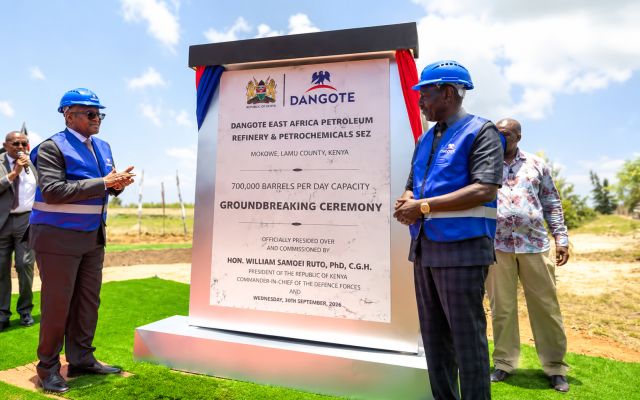
Work has officially begun in Lamu on the huge Dangote refinery, an investment of around 2,200...
NEWS
by redazione

The construction of the port of Lamu is 20 percent.
He said yesterday the press the director of Lappset project (Lamu Port South Sudan Ethiopia) Silvester Kasuku.
According Kasuku have already been prepared three docking and the first will already...
ENVIRONMENT
by redazione

The Arabuko-Sokoke forest, which extends between the hinterland of Malindi and that of Watamu and Kilifi, has been included in the...
TOURISM
by Leni Frau

Today sees the start of the 22nd Lamu Cultural Festival in the beautiful and still unspoilt...
NEWS
by Leni Frau

Among the 13 unspoiled wonders of the world, in the country category, there is also a renowned...
MARINE ENVIRONMENT
by Freddie del Curatolo

From Lamu to Shimoni, via Malindi, Watamu and Mombasa, Kenya’s coastline is home to one of...
ENVIRONMENT
by Freddie del Curatolo

It is one of those rare news stories that does not smell of burning, even though it is about coal. The...
FESTIVALS
by Freddie del Curatolo

The poet Paolo Conte, to feed his beloved's 'Arabian dream', offered the afternoon moon and...
EVENTS
by redazione

Kicking off today is the 20th Lamu Cultural Festival, one of the most important events of its kind in Kenya...
KENYA NEWS
by Freddie del Curatolo

UNESCO, which occasionally likes to remind us that the Earth is not yet an open-air shopping centre, just...
EDITORIAL
by Freddie del Curatolo

In the end, it was neither South Sudan’s oil nor Ethiopian trade, nor even the grand Sino-African strategic...


