
23-09-2024 by Freddie del Curatolo

Buying a piece of land or a ready-made house in Kenya? It may be worth it, but know that you will never really own it and that one day (not you, barring incredible longevity, but your heirs) you may lose it.
Let's see why.
It is worth knowing that a foreigner who buys land in Kenya, according to the Land Act included in the constitution promulgated in 2010, will never own it again, as can be the case in Italy. Not even if he is a resident of Kenya.
And above all that after 99 years from the purchase of the land, if the document certifies that it is ‘leased’ land, he will lose ownership, even if it was purchased before 2010.
So it is a retroactive law.
Also be aware that whatever they tell you or promise you, there are no possible loopholes.
And that the law is evolving, so it could bring with it other unpleasant surprises.
If, in fact, before the constitutional change, building and non-building properties were divided into ‘Freehold’ (eternal title) and ‘Leashold’ (property leased for 99 years), today the former is reserved for Kenyans only.
Mind you: the law is retroactive, so a foreigner who holds a ‘freehold’ title will see it transformed into a ‘leasehold’ and will only be able to sell it as such, eventually having it taken away from him (him or his heirs) after the fateful 99 years.
Previously, the Land Act stated that after the expiry of 99 years, the rightful owner had the option to renew the leasehold, but a new article in the Land Act will no longer allow foreigners to exercise this option.
WHAT THE LAW SAYS
Section 13 of the Land Act, in fact, states that ‘when land reverts to the national or county government, after the expiry of the lease, the commission shall offer the immediate previous lease holder a right of first refusal to assign the land, provided that such lessee is a Kenyan citizen and the land is not required by the national or county government for public purposes.’ Upon expiration or termination of a lease held by a non-citizen, therefore, the land will pass to the national or county government.
Obviously the same applies to land where residences, resorts, or flats have been built.
Are you the owner of a property built on land owned by a company in which foreigners are listed? It is worth asking when the leasehold was last renewed! Remember that the classification of land and the issuance of the first leasehold titles started when Kenya became a colonial state, i.e. after 1920. So in theory we could also have leasehold land expiring in these very years. And let it be known that if a leasehold land was transferred to a new leaseholder, he inherited the expiry date, which was by no means reset (as some believed or propagated).
HOW DOES LAND CLASSIFICATION IN KENYA WORK?
Land in Kenya has been classified into the following categories under the new laws.
Public land, community land and private land.
Public land includes land occupied by organs of institutions, land transferred to the state, land for which no heir can be identified, forests, reserves, national parks, watersheds, seas, lakes, rivers, and land between high and low tide. The National Land Commission is responsible for public lands.
Community lands are those that ancestrally belong to tribal groups, villages and organised communities of residents. These lands must be legally registered in the name of representatives of a CBO (Community Based Organisation), a recognised ethnic or social group or any other organisation. With these prerequisites, the land must be declared communal by an act of parliament.
Finally, private land is ‘freehold’ or ‘leasehold’ land owned by or leased to individuals or companies.
Here it should be pointed out that freehold land owned by a foreigner, even if it is jointly owned with an African (this seemed to be the ploy after 2010) will still be downgraded to leasehold property. Ditto if it is a company where a Kenyan non-citizen appears, even at one per cent.


NEWS
by redazione

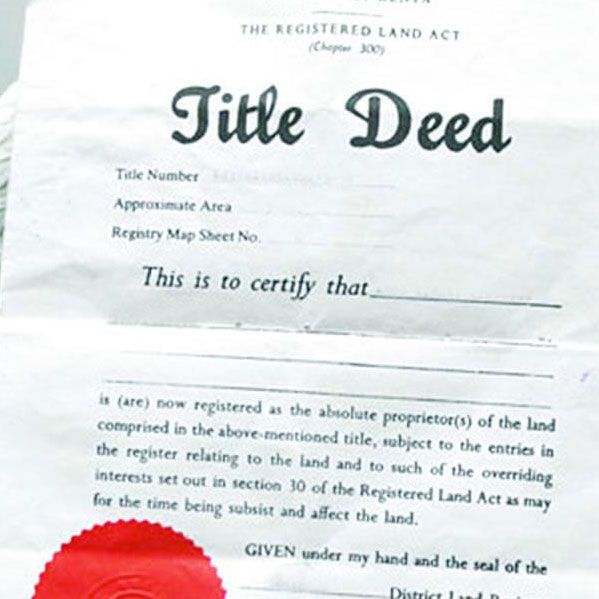
Doing research for the title deeds (title deed) from now on will not cost anything.
As you will soon be speeded practices to know if a title deed is vacant or has an owner, if it is locked or what...
DOCUMENTS
by redazione
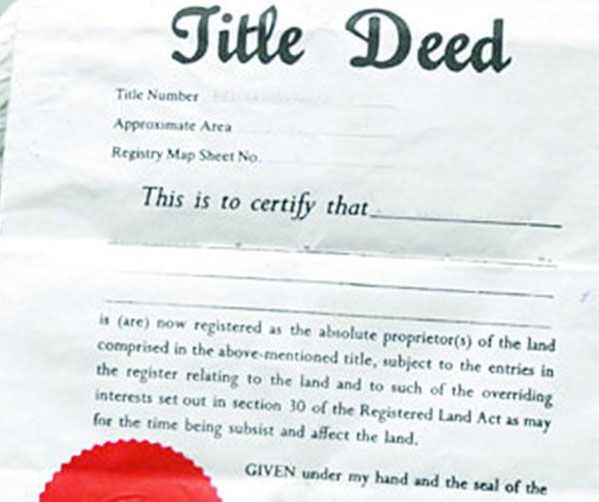
In Kenya, losing the title deed – the certificate attesting to ownership of land or a property – can...
INVESTMENTS
by redazione

Mayungu will be the next frontier of coastal tourism. The fishermen's village between Malindi and Watamu is evolving, among the latest land and property sales (even Nairobi's prominent figures have purchased plots or existing homes) and the resolution of many...

In Malindi back to buy and sell real estate.
It's because of the expansion of a town that is now only a tourist phenomenon but a residential center where the quality of life moves the bar no longer fixed on...
NEWS
by redazione
The process of digitisation of Kenyan bureaucracy, which has already affected various sectors...
EDITORIAL
by Freddie del Curatolo

INFORMATIONS
by Freddie del Curatolo

Come potevamo immaginare, l’articolo che abbiamo pubblicato ieri riguardo alla proprietà di...
NEWS
by redazione

A new land acquisition by the Ministry of Transport, the purchase of other 22.4 hectares of land to ensure the expansion of the airport in Malindi International.
KENYA NEWS
by Freddie del Curatolo

REAL ESTATE
by redazione

It is time for property investments in Malindi, considered one of the most advantageous and...
BUSINESS
by redazione

Leading Real Estate agencies in Nairobi have ranked Malindi second overall, after Nanyuki, for...
FREDDIE'S CORNER
by Freddie del Curatolo

We have always been on the move, nomadic souls.
Maybe...
LUTTO
by Freddie del Curatolo

He played the role of an unscrupulous poacher in the docu-fiction "Poacher," which brought the backstory of the...


