
INSIDE KENYA
11-09-2026 by Freddie del Curatolo

In Kenya, medicine has never been just a matter of white coats, pills, and medical reports.
That has always been a “private matter.”
The public matter, close to the people, is a story told in a whisper, a root pounded in a mortar, a prayer said softly so as not to disturb the spirits, trust placed in someone who “knows.”
They know where that leaf grows, they know how to talk to pain, they know how to keep hope alive when the hospital is far away, closed, or simply too expensive.
The Mijikenda people know this well, as they have never truly separated the body from the spirit in their kaya. Illness is not just a mechanical failure: it is an imbalance, an invisible fracture between man, the community, and his surroundings. And within that universe of ancient knowledge, handed down by memory rather than on paper, there are concoctions that really work. Decoctions that calm fevers, barks that help wounds, roots that keep minor infections at bay before they become monsters. This is not folklore: it is backed up by studies, observations, and even laboratories which, centuries later, have discovered that African grandparents were not so naive after all.
The paradox arises today, in modern Kenya, which is racing ahead without taking a breath. Because while Nairobi is building skyscrapers, in the countryside and suburbs, public health care often remains a mirage. Clinics without medicine, hospitals where you pay even for the air, doctors as scarce as water in the dry season. And so traditional medicine is not a romantic choice: it is the only one left. It is the door that is always open when all the others are closed.
But then comes faith, armed with microphones, lights, and slogans. And there, something breaks.
The news reports of recent days tell the story without poetry. In Nakuru, during a ‘prophetic healing’ crusade, a licensed doctor claimed to have healed people with HIV/AIDS, the blind and the crippled. Words as heavy as stones. Words that do not remain suspended in the air, but end up straight into the veins of those who are desperate. The government, through Health Minister Aden Duale, has announced zero tolerance: investigations, suspensions, revocation of licenses. The Kenya Medical Practitioners and Dentists Council has been tasked with verifying every claim, every file, every alleged miracle.
It is a hard line, and in some ways inevitable. Because HIV is not a stomach ache that goes away with herbal tea. It is a chronic condition that requires ongoing care, treatment, and monitoring. Telling someone they are cured without scientific evidence means pushing them, perhaps, to stop taking their medication.
And that is no longer faith: it is Russian roulette.
The government has made it clear, even from Eldoret: spirituality is respected, but people's lives are not; they are not to be gambled with. And the specter of Shakahola, with its mass graves and madness elevated to doctrine, still looms as a warning that Kenya cannot afford to ignore.
Yet, stopping at repression risks being too easy. Because the problem is not just improvised prophets or doctors who forget their oath for a crowded pulpit. The problem is the void. That enormous void left by a state that fails to provide decent care for the poorest. In that void, sects, miracle healers, and preachers promising immediate salvation thrive. Not because people are stupid, but because they are alone.
Here, traditional medicine is often lumped together with witchcraft, superstition, and deception. And it is a convenient mistake. Because it means not distinguishing between those who really know plants and those who sell illusions, between those who treat minor ailments with empirical expertise and those who claim the right to ‘cure’ lethal diseases without proof. It means ignoring the fact that in many rural communities, the herbalist is also the first health filter, the one who refers patients to the hospital when he realizes that a root is no longer enough.
Criminalizing everything is easy. Understanding is more difficult.
The uncomfortable truth is that traditional and modern medicine in Kenya have always coexisted, often without communicating with each other. One is tolerated as long as it does not make too much noise, the other is invoked as the only truth even when it does not work. In between are the poor, forced to choose not the best treatment, but the one that is possible.
Perhaps the right question is not whether to repress or not, but how to integrate without betraying. Seriously study what works, regulate without humiliating, educate without destroying. And above all, rebuild a public health system that does not force people to seek miracles because they cannot afford a visit.
Kenya does not need prophets who promise instant cures, nor witch hunters in white coats. It needs respect for its history and responsibility for its future. Because between a leaf that really heals and a lie that kills, the difference is not made by faith. It is made by conscience.


EVENTS
by redazione

Today in Malindi is celebrating the popular heroin of Mijikenda Mekatili Wa Menza culture.
This is the most important traditional celebration of the Kenyan coast population. The Mijikenda ethnicity represents the nine tribes living north of Malindi to the border with...
EVENTI
by Leni Frau

As every year in these days, the Mijikenda ethnic group of the Kenyan coast and in ...

A unique event that unites the culture of the Kenyan coast, the Mijikenda ethnicity, art and cultures from around the world, through the essential vehicles of music, words and visual art. All together in an evening entitled "The Earth and...
STORIES
by Freddie del Curatolo

Clouds come and go, like emotions. At the equator they are so low, so close that you feel they are...
EVENTS
by redazione
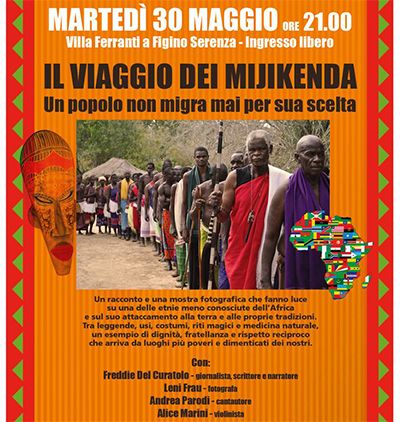
An evening of stories about Kenya and the Mijikenda ethnicity this Tuesday at Figino Serenza in the province of Como.
With free entrance, in the beautiful and elegant frame of Villa Ferranti, the headquarters of the municipal library, Malindikenya.net's director...
EVENTS
by redazione

An event of traditional coastal music, folk dances and other activities in the shade of one of...
by redazione

An unusual Friday in the setting of the restaurant La Malindi. In addition to the weekly evenings with live...
STORIE
by Freddie del Curatolo

Even today the coast of Kenya, where civilization in many ways has descended like a cleaver on centuries-old...
FREDDIE'S CORNER
by Freddie del Curatolo

There are images that speak louder than a thousand words.
Sun-dried...
EVENTS
by redazione

An Easter of music and beauty from Africa and good things from Italy at Olimpia...
EVENTS
by redazione

After guitar workshops and internships in the Nairobi slums and at the conservatory, and two applauded...
NEWS
by Leni Frau

Wanting to sell a pangolin on the black market, three men from Kinango in the coastal county of...


