
KENYAN PRODUCTS
09-02-2025 by redazione

For those who love vegetables, and especially leafy vegetables, East Africa is a bit of paradise. Once you've established the origin, authenticity and minimal use of pesticides, the choice is really varied and very tasty.
Just think of the many varieties of spinach and wild herbs, which produce nuances, even minimal but essential, to change your diet and recipes.
Often you need to know the original names, sometimes not even the Swahili ones but the dialectal ones, in order to be able to distinguish and therefore ask the trader for the right variety.
Those familiar with Kenya have by now learned to distinguish, for example, sukuma wiki (a leaf from the Brassicaceae family, therefore cabbage and turnip, but with a flavour tending more towards chicory) from mchicha, which is an amaranth, similar to spinach), but at the market and on the stalls of Kenyan ‘mamas’ there are many other green wonders; managu (or mnavu), more bitter (‘African nightshade’, also because belladonna is poisonous) and mchunga, for example.
Today we're talking about the delicious kanzira, also called Abyssinian cabbage.
The leaves of this cabbage, which apparently originates from the Ethiopian highlands, are particularly tender and flavoursome and are now commonly used throughout East Africa. They can be eaten raw, together with the stalks, but kanzira is often boiled in very little water. The flavour is delicious and distinct and they are rich in nutrients such as protein, fibre, vitamins and folic acid. The plant is often cultivated together with other traditional leafy vegetables. As well as being eaten, kanzira is also used for its medicinal properties. The seeds of this plant are known for their effectiveness in treating stomach pains, while the water used to boil the leaves is believed to be useful for diarrhoea. The seeds of kanzira are called ‘Ethiopian mustard’ and are also used to flavour marinated meat. According to traditional medicine, the seeds can help in the alternative treatment of cancer.
Here is a Kenyan recipe with kanzira:
Ingredients: 100g kanzira leaves
1 cup water
1 tablespoon vegetable or clarified butter
1 onion
2 tomatoes
1/3 cup coconut milk
Salt and pepper to taste.
Preparation
After cutting the lower part of the stems, wash and drain the kanzira, then chop it.
Blanch for 3 minutes in salted water, then rinse with cold water to maintain the colour and nutrients of the leaves.
Melt the butter in a frying pan and fry the onion and pepper until golden brown. Add the chopped tomatoes and leave them to soften, without overcooking them to preserve more of the heat-sensitive vitamins. Add the kanzira and cook for another 3 minutes. Add the coconut milk and stir until smooth, then turn off the heat. This dish is ideal as a side dish for meat, chicken or fish, but also as a vegetarian first course accompanied by ugali, the local polenta. Mchicha (terere) can be added to kanzira if you want a combination of different flavours, or managu (mnavu) if you like it with a hint of bitterness, which the coconut sweetens anyway.


LOCAL PRODUCTS
by Leni Frau

by redazione

Even the Kenyan coast has its 'zimino'. The dish of fish and leafy vegetables, which in...
VEGETABLES
by redazione

Among the many leafy vegetables that Kenyans usually eat (and are often forced to eat due to their...
VEGETABLES
by Leni Frau

Some call it 'African Nightshade', but its scientific name is 'Solanum...
LOCAL RECIPES
by redazione
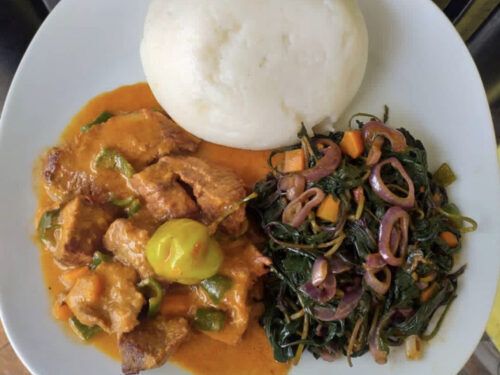
It is the Kenyan national dish, maize flour polenta (white) with an accompanying side dish with tomato...
NEWS
by Freddie del Curatolo

Hunger is gripping Kenyans on the eve of the general elections, and after Nairobi and Mombasa, stocks...

Today's Kenya Song is a playful song by children in rural areas (practically 90% of the territory) who...
NEWS
by redazione

The method is the artisan one to produce very normal candles: a gas stove, classic ...
KENYA RECIPES
by Leni Frau

Those who frequent Kenya will surely have heard the name ‘Tilapia’ and will often have found it on...
LOCAL FOOD
by Freddie del Curatolo

Those familiar with Kenya, markets and 'street food' will already have come across the piles of dried...

On the Kenyan coast, the local population, especially those of distant Arab origin, have...

The new market of Malindi is real, now they have to think to manage it in the best possible way.
Every ...


